A parcel register tells you the truth about a property. Who owns it. What’s registered against it. What chains of charges came and went. Lawyers pull parcel registers at every closing, but the broker who can read one before submitting a file catches problems early and avoids the awkward call to the borrower three weeks in.
This article walks through what’s on a parcel register, what each section means, and where the traps are. By the end you’ll be able to pull one, read it, and use it.
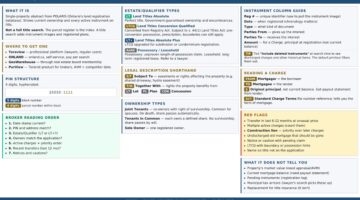
Download the Quick Reference Guide
A parcel register tells you the truth about a property. Who owns it. What’s registered against it. What chains of charges came and went. Lawyers pull parcel registers at every closing, but the broker who can read one before submitting a file catches problems early and avoids the awkward call to the borrower three weeks in.
This article walks through what’s on a parcel register, what each section means, and where the traps are. By the end you’ll be able to pull one, read it, and use it.
What a parcel register actually is
A parcel register is a single-property abstract from POLARIS, Ontario’s electronic land registration database. It shows the current ownership of one parcel of land plus every instrument currently affecting that parcel. Transfers, charges, discharges, easements, notices, cautions, liens. All of it lives on the parcel register.
Important distinction: a parcel register is not a property title search. A full title search adds the underlying instrument images (so you can read the actual mortgage documents, the actual easement language) and the registered plans (so you can see boundaries). The parcel register is the index. The title search reads the books.
For most broker due diligence work, the parcel register alone is enough.
Where to get one
Three main channels.
- Teraview. The professional platform, used by lawyers, paralegals, title searchers, and anyone who pulls parcel registers regularly. Subscription based. You can search by PIN, name, or address, then download the parcel register as a PDF.
- ONLAND. The self-service portal at onland.ca. Designed for occasional users. Pay per search, no subscription required. The interface is consumer-friendly, but the search options are more limited than Teraview’s.
- GeoWarehouse. Used by real estate professionals through their board membership. Bundles parcel register access with comparable sales data and neighbourhood reports. Mortgage brokers often access it through a partnership with a real estate brokerage.
- There’s also PurView, a Teranet product targeted at mortgage brokers specifically. Subscription model. Adds AVM data and competitor mortgage information to the parcel register view.
What’s on the document
A parcel register is usually one to four pages. Standard layout:
- Date stamp (top right). Always check this first. If the document was generated two weeks ago, you may be missing recent registrations. Pull a fresh one if anything has happened on the file since.
- PIN (Property Identification Number). Nine digits. The first five identify the block, the last four identify the specific parcel within that block. So PIN 25050-1111 sits in block 25050 as parcel 1111. The PIN is the unique key for the property in POLARIS.
- Legal description. A formal description of the property’s location, lot number, plan number, and any conditions. Look for shorthand. “S/T” means “subject to” and signals easements or other rights affecting the property. “T/W” means “together with” and signals rights the property benefits from.
- Estate/Qualifier. Tells you which land registration regime applies. This is critical. More on the types below.
- Registered owners. Names of the current legal owners and how they hold title. Common types: “Joint Tenants” (with right of survivorship, common for spouses), “Tenants in Common” (each owns a defined share, no survivorship), or sole ownership.
- Instruments. The chronological list. Every transfer, charge, discharge, easement, notice, caution, lien. Each line has an instrument number, date, type, and the parties involved.
The Estate/Qualifier code
This is the part that confuses new brokers. Ontario has two land registration systems that co-exist, and which one applies determines what kind of guarantee the government provides for the title.
- Land Titles Absolute (LT). A perfect title. The Ontario government guarantees ownership and the listed encumbrances are the only encumbrances. Originally registered under Land Titles, or upgraded from the older Registry system through a First Application. This is the cleanest qualifier.
- Land Titles Conversion Qualified (LTCQ). The Estate/Qualifier reads “Fee Simple LT Conversion Qualified.” The property was originally under the Registry Act and was administratively converted to Land Titles, which is what the province did to almost all Registry properties between the mid-1990s and the early 2000s. The title is still subject to subsection 44(1) of the Land Titles Act, which preserves pre-conversion rights: adverse possession claims, prescription, misdescription, boundary issues. In practice, most LTCQ properties are fine, but the qualifier flags that historical claims could theoretically resurface.
- Land Titles Absolute Plus (LT+). An LTCQ property that has been upgraded to absolute status. Usually done because the property is being subdivided or registered as a condominium, which Land Titles does not permit on LTCQ parcels.
- Possessory and Leasehold. Rare. Possessory titles cover ownership claims based on length of possession that haven’t been fully proven. Leasehold titles cover long-term leases that have been registered. Not common in residential brokering.
The day-to-day impact for brokers: LT and LT+ are clean. LTCQ is fine but worth a second look if there are unusual boundary or possession issues. Possessory is a hand-off-to-the-lawyer situation.
Reading the instruments list
Each line on the parcel register represents one registered document affecting the property. The columns:
- Registration number. The unique number for the instrument. If you want to pull the actual document (the mortgage agreement, the easement language, the discharge), this is the number you use.
- Date. When the instrument was registered. Important for chronology.
- Instrument type. Examples: Transfer, Charge, Discharge of Charge, Notice, Caution, Construction Lien, Application.
- Parties From. The person giving up the interest. For a charge, this is the mortgagor (the borrower). For a transfer, this is the seller.
- Parties To. The person receiving the interest. For a charge, this is the mortgagee (the lender). For a transfer, this is the buyer.
- Amount. For a charge, the principal amount of the mortgage at registration. Does not show the current balance, just the original face value.
- Certificate or remarks column. Sometimes contains useful annotations like “Standard Charge Terms file number 200033” for a mortgage, or a brief description of the easement.
What to look at first
When I pull a parcel register, my reading order is:
- Date stamp. Is this current?
- PIN and address. Does this match what I’m working with?
- Estate/Qualifier. Anything other than LT or LT+ deserves a second look.
- Registered owners. Do these match the names on my application? If a spouse is on title but not on the application, I need a Spousal Consent or to add them.
- Active charges. How many active mortgages? Each charge that hasn’t been discharged is a live encumbrance. The order they appear is the order of priority.
- Recent transfers. Has the property changed hands recently? A transfer within the last six months can be a fraud red flag or simply a recent purchase. Worth asking the client about.
- Notices and cautions. Anything that flags a pending claim, a dispute, or a restriction. Construction liens are particularly important: they have priority over later mortgages.
What it doesn’t tell you
The parcel register has limits. Know them.
- It doesn’t tell you the property’s market value. For that you need an appraisal or AVM.
- It doesn’t tell you the current balance on an existing mortgage. The amount shown is the original principal at registration. The actual payout balance comes from the lender’s payout statement.
- It doesn’t show pending instruments. If something was submitted yesterday but not yet processed, it may not appear. Most institutional lenders pull a fresh parcel register at funding to catch this.
- It doesn’t show municipal tax arrears, utility liens not yet registered, or assessments not yet rolled into a registered notice. These usually surface during the lawyer’s title search and statutory inquiries.
- It doesn’t replace title insurance. The parcel register is a description. Title insurance is a contract that defends the owner if the description is wrong.
How brokers actually use it
Three practical use cases.
- Pre-submission validation on a refinance. Pull the parcel register before submitting. Confirm ownership matches the application. Confirm the existing charges are what the client said they are. Calculate the available equity yourself by comparing the charge amounts to your estimated value. Catch any surprise encumbrances before the underwriter does.
- Verifying the discharge at funding. When a refinance pays out a prior mortgage, the prior lender’s lawyer registers a Discharge of Charge. After funding, you should see that discharge on a fresh parcel register. If it’s not there 30 days post-closing, follow up. An undischarged prior mortgage is a title problem.
- Spotting things the client didn’t mention. Clients sometimes forget to disclose a second mortgage, a co-signed loan secured against the property, or a construction lien from a recent reno. The parcel register tells you the truth. Use it.
What to do when you find a problem
You’ll spot things. Here’s what to do.
- A name on title that’s not on the application: ask the client. Could be a spouse, parent, business partner. The fix depends on who and why.
- A recent transfer at an unusual price: ask the client. Could be a family transfer for nominal consideration, could be a flip. Investigate before submitting.
- An undischarged old mortgage: usually a paperwork lag from a prior payout. Ask the borrower to follow up with the previous lender’s lawyer. If it’s recent, you may need to wait for the discharge before proceeding.
- A construction lien: significant. Construction liens get priority over later mortgages. Most institutional lenders will not fund until the lien is discharged or bonded.
- A notice or caution: read what it says. Notices range from minor (a Planning Act compliance issue) to serious (pending litigation over the property). Get your principal broker or a lawyer involved if you’re unsure.
The takeaway
Every broker should pull and read parcel registers as part of pre-submission due diligence. The cost is small. The time investment is ten minutes. The number of problems you’ll catch before they reach the underwriter is significant.
The skill takes practice. The first parcel register you read will feel cryptic. The fiftieth will feel routine. By the hundredth, you’ll be spotting issues in ninety seconds.
Build the habit early. It’s the single most useful piece of due diligence a Level 1 broker can do.