Everybody can see the licensing part. There’s a course, an exam, and a registration number at the end of it. What happens in the 90 days after that is far less visible and far less measured. So we asked 880 people who lived through it.
880 mortgage agents answered this survey between August 31 and September 14, 2026. If you were one of them, thank you.
What we found
- A third of newly licensed agents got no real training in their first 90 days at a brokerage.
- Those agents were more than twice as likely to leave. 35.5% are gone. For agents who got a structured program, it was 16.7%.
- 36.9% have never funded a deal. That’s 289 respondents who became licensed but reported never funding a deal
- What they said was missing was the job itself. Lender systems, documents, building a file, finding clients.
- 69% wanted a credential they could take with them from one brokerage to the next.
In this report
- Why we ran this
- A third of them got nothing
- The ones who got nothing are the ones who left
- They rated it honestly
- 37% have never funded a deal
- What was missing was the job itself
- Most of them paid for it themselves
- The 96 who never got started
- Seven in ten want a standard they can take with them
- What we take from this
- Method and limitations
Why we ran this
Getting licensed is the easy part. It’s regulated, it’s measured, and everyone can see it happen.
After that the lights go out. An agent joins a brokerage, and a year later they’re either building a business or they’ve stopped answering their phone. There is no public, industry-wide dataset showing what happens to new agents after licensing or why some succeed and others leave. Brokerages may know their own numbers, but there is very little visibility beyond that.
We have a list of people who got licensed with us. So we asked them what happened next.
Between August 31 and September 14, 2026, 880 of them answered. 784 went on to get licensed. 96 finished the course and never did.
A third of them got nothing
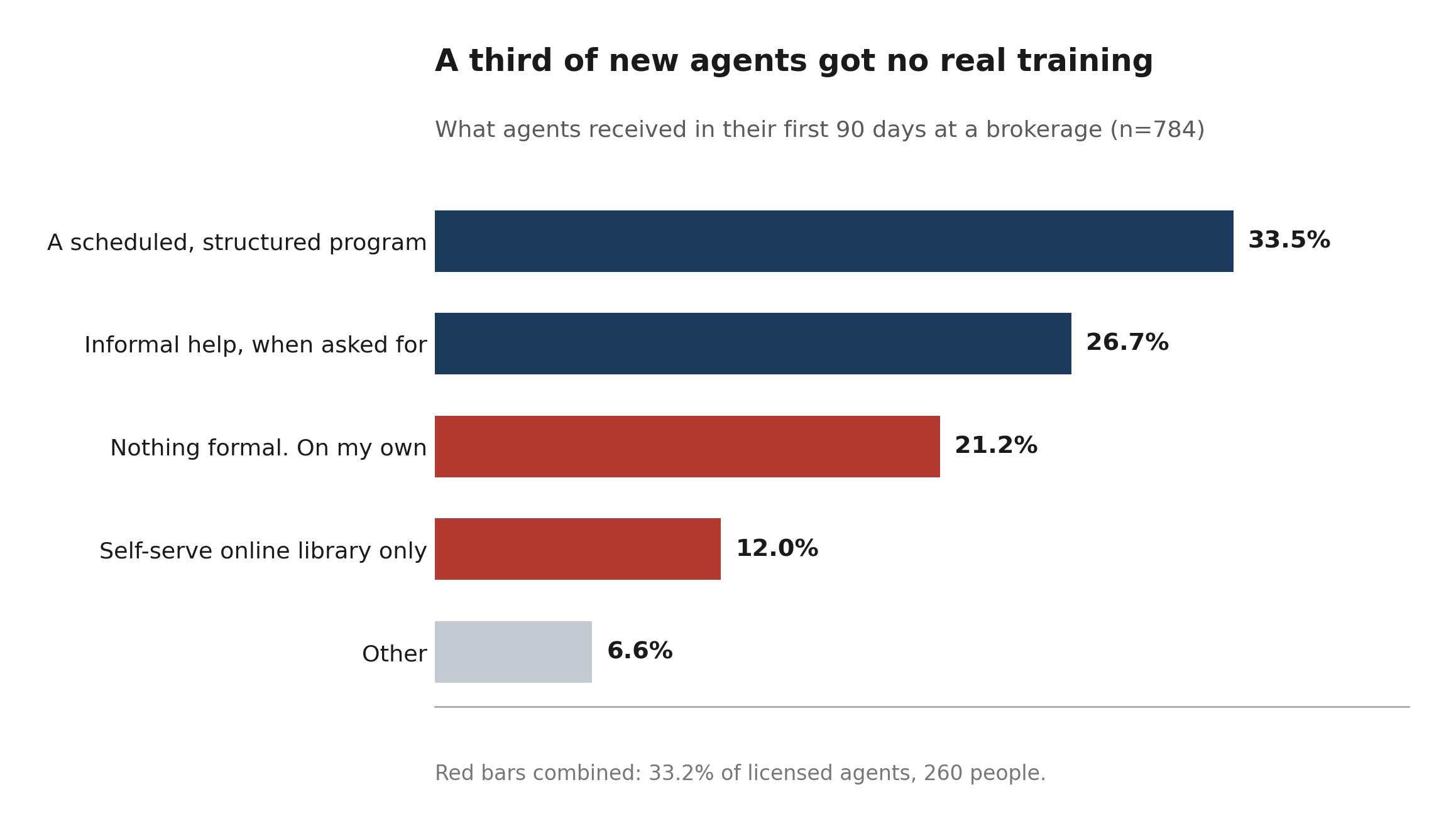
What agents received in their first 90 days at a brokerage. Source: REMIC, The First 90 Days, 2026.
166 agents told us they got nothing formal and worked it out alone. Another 94 got handed a login to an online library. Put those together and it’s 260 people, a third of everyone licensed in this survey, who got a licence and then got left alone with it.
Some of the write-in answers were one word long. “Zero.” “Nothing.” “No training at all.” One agent asked for training, got a single conversation about marketing, was given a list of things to go do, and never heard from anybody again. Another described a brokerage that wanted their client information handed over to a senior agent, because they were new, and taught them nothing in return.
Then there’s the other end of it. Weekly sessions for new agents. A daily deal run anybody could sit in on. A team lead who picked up the phone when the training didn’t cover whatever was in front of them. Those brokerages exist and they’re doing it properly.
That’s the real finding here. This industry isn’t uniformly bad at training new agents. It’s all over the map. And a new agent has no way of knowing which kind of shop they’ve walked into until they’re already in it.
The ones who got nothing are the ones who left
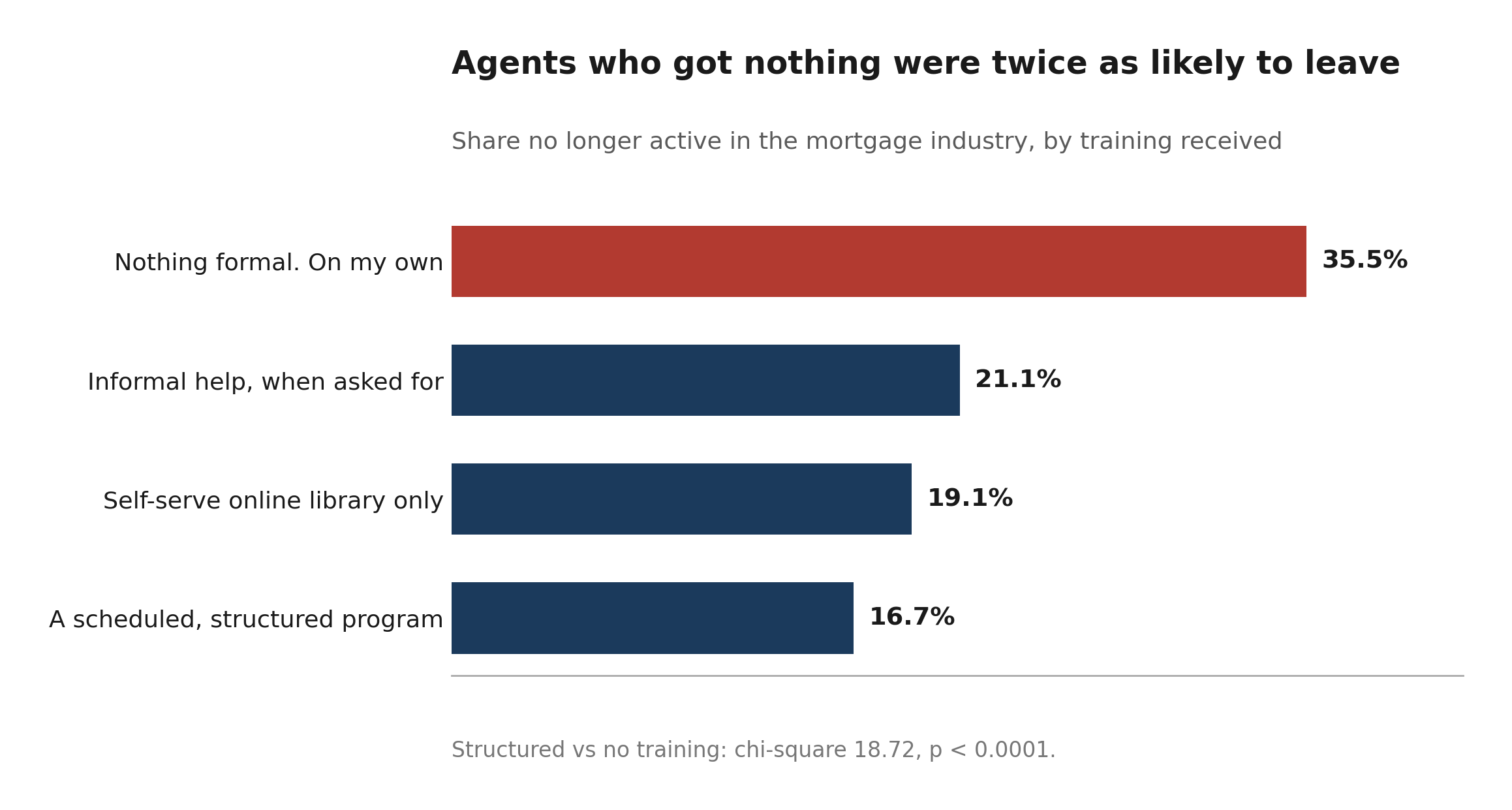
Share no longer active in the industry, by training received. Source: REMIC, The First 90 Days, 2026.
Better than twice the attrition. Run the structured group against the no-training group and the odds of that being coincidence are under one in ten thousand (chi-square 18.72, p < 0.0001).
Now the honest caveat, because we’d rather say it than have somebody else say it for us. This doesn’t prove training by itself keeps people in the business. A brokerage that builds a real program probably does a lot of other things well too, and agents with more runway may be picking better brokerages in the first place. We can’t separate those out of this data. But a gap that size is hard to wave away.
We also asked the 94 agents who left why they went.
| Reason for leaving | Share |
|---|---|
| No leads or clients | 39.4% |
| Lack of training or support | 29.8% |
| Fees and cost of staying licensed | 20.2% |
| Took other work | 9.6% |
Almost a third put it down to training directly. And the biggest answer, no clients, is arguably the same complaint under a different name, because finding clients was also the number one thing agents told us their training never covered.
They rated it honestly
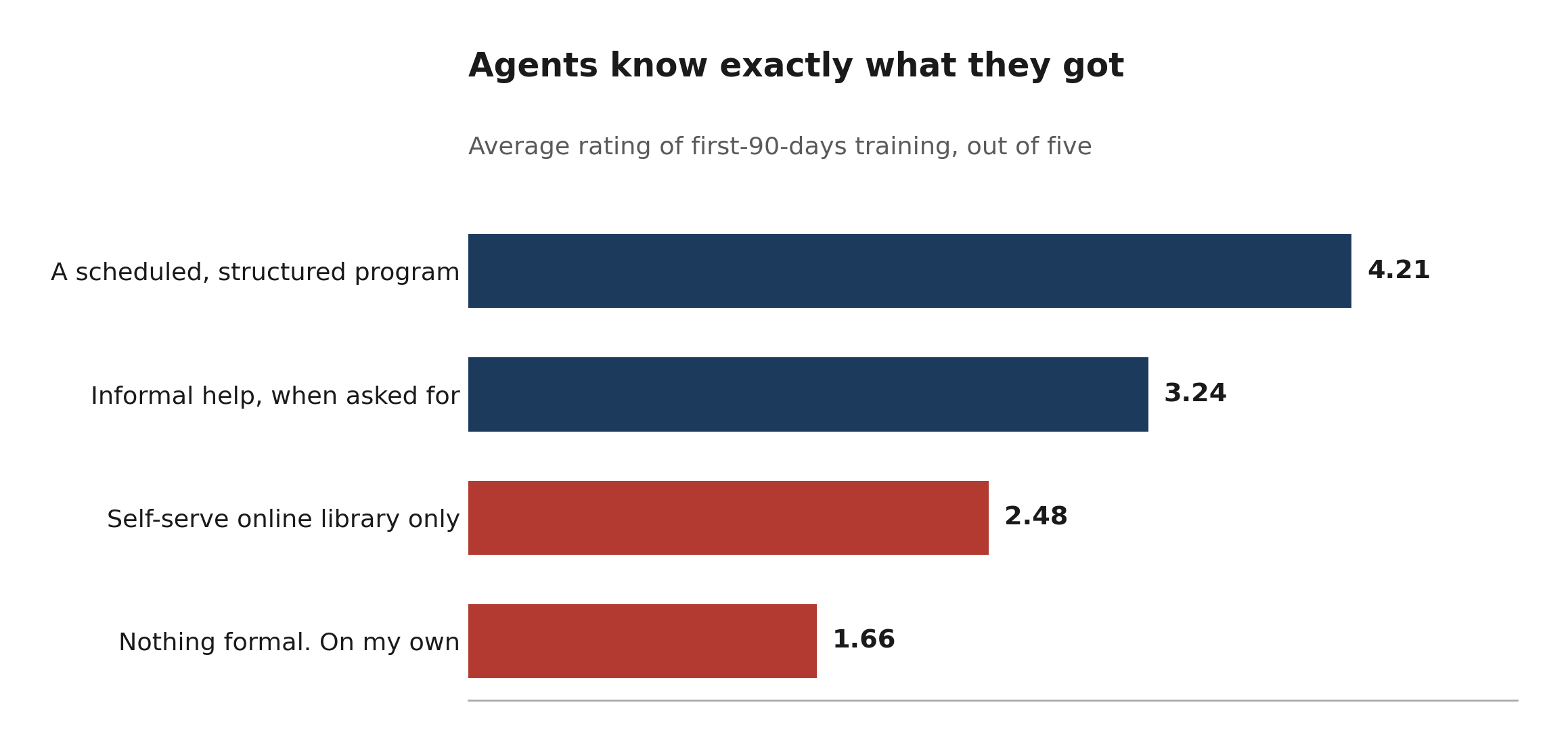
Average rating of first-90-days training, out of five. Source: REMIC, The First 90 Days, 2026.
Across everybody, the average score was 3.10 out of five. That number tells you almost nothing, because hardly anyone landed in the middle. 164 agents gave their training a one. 188 gave it a five.
Break it out by what they actually got and the picture sharpens right up. Structured programs averaged 4.21. No formal training averaged 1.66.
Agents know what happened to them. When a brokerage puts a real program in front of them, they say so. When it doesn’t, they say that too.
One more number worth sitting with. We asked how much training influenced which brokerage they picked. 39.3% weighted it heavily. But 24.2% said it played no part at all. We’d guess that’s not because it didn’t matter. It’s because nobody told them to ask.
37% have never funded a deal
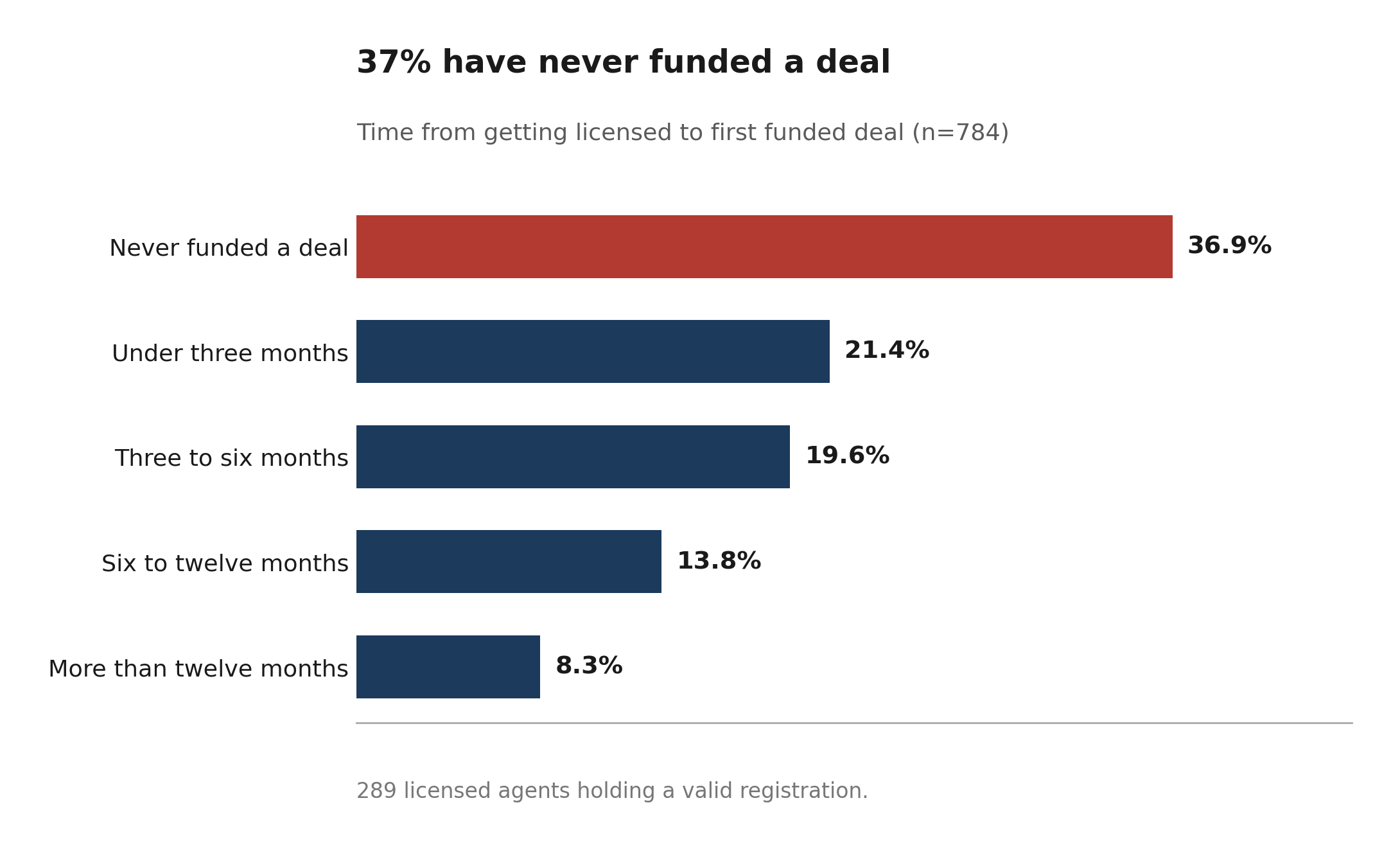
Time from getting licensed to first funded deal. Source: REMIC, The First 90 Days, 2026.
289 agents. Licensed, registered, and they’ve never closed a single transaction.
That’s the number that stopped us.
What was missing was the job itself
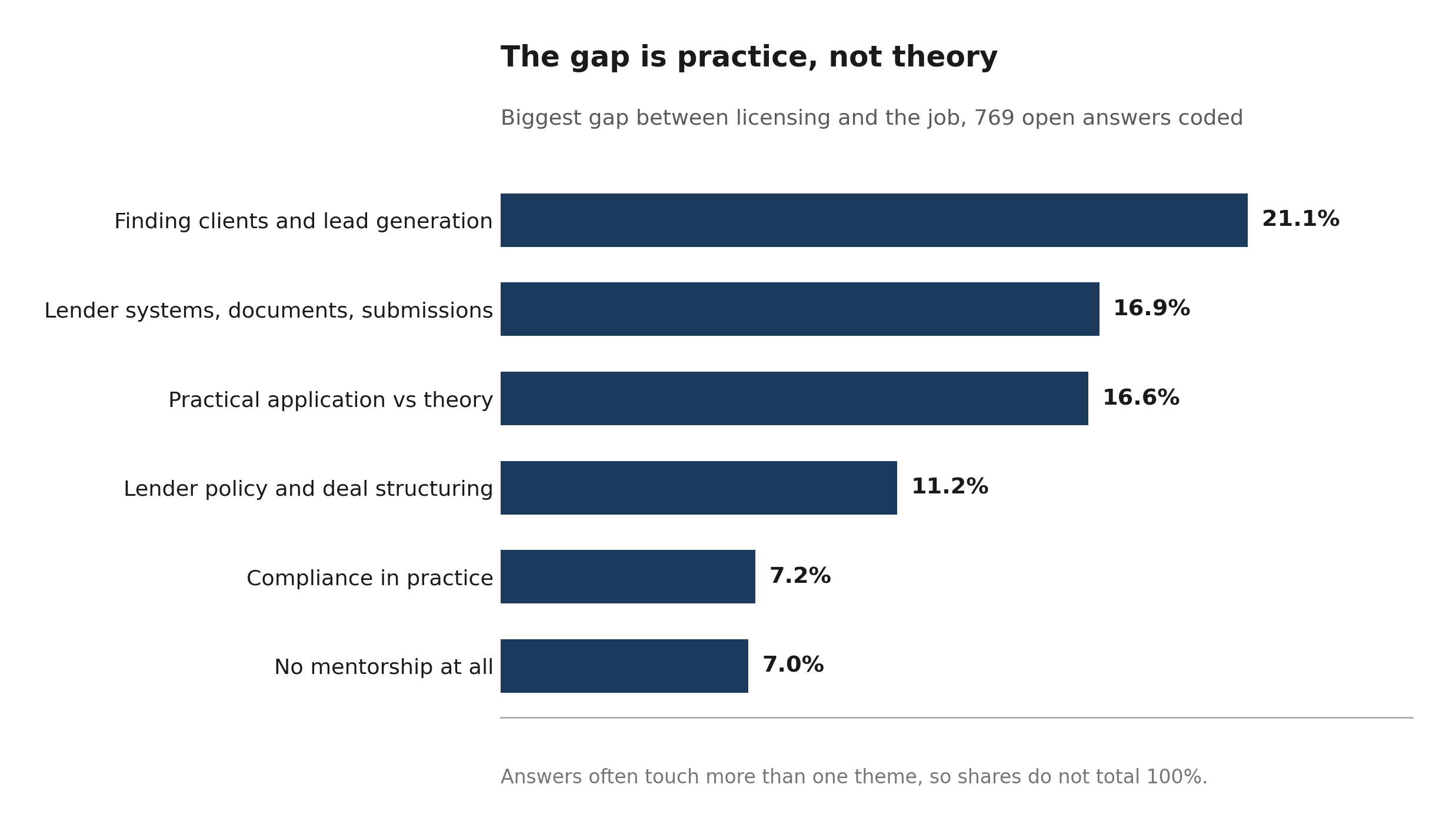
Biggest gap between licensing and the job, from 769 open-text answers. Source: REMIC, The First 90 Days, 2026.
769 agents answered an open question about the biggest gap between what they learned to get licensed and what the job actually asked of them. We coded the answers into themes. Plenty of answers hit more than one, so the shares don’t total 100%.
Hardly anybody said the rules were the problem. They knew the rules. What they didn’t know was which lender to send a file to, what documents that lender would want, how a submission gets built, and where the clients were supposed to come from.
Here’s how they put it.
The licensing course covered the rules and fundamentals, but didn’t fully prepare me for qualifying clients, structuring deals, navigating lender guidelines, and managing the application process in practice.
Agent licensed in 2025, no formal training
Figuring out what lender to send the deal to. With so many lenders your onboarding with, it’s hard to determine the home of best fit.
Agent licensed in 2025, no formal training
Most understand how mortgages work, not many seem to know how the actual funding process works.
Agent licensed in 2025
We do a LOT of alternative and private deals which was non existent in the licensing training.
Agent licensed before 2024
And then this one, which changed how we read the whole survey.
Getting clients was the difficult part. I had all the support needed to close the deal.
Agent licensed before 2024, structured training program
Listen to the difference. That agent has a business problem. Every broker in the country has had that problem and survived it. The agent who doesn’t know how to build a file has something else going on entirely, and it’s the brokerage that put them there.
Worth separating two of these themes. Finding clients is a sales skill, and it sits outside the core purpose of mortgage licensing education. Fair enough. But lender systems, document requirements and file assembly are completely teachable, and 16.9% of agents named that as the wall they hit.
Most of them paid for it themselves
| Paid out of pocket in first year | Share |
|---|---|
| Nothing | 42.1% |
| Under $500 | 21.4% |
| $500 to $1,500 | 22.2% |
| $1,500 to $5,000 | 12.8% |
| Over $5,000 | 1.5% |
Close to six in ten reached into their own pocket for training, on top of what they’d already paid to get licensed and what the brokerage was charging them. One in seven spent more than $1,500. All of this in a first year where 36.9% of them hadn’t funded anything yet.
The 96 who never got started
96 people finished the licensing course and never got licensed. We asked them why.
| Reason | Share |
|---|---|
| Could not find or join a brokerage | 41.7% |
| Other work or no time | 28.1% |
| Brokerage fees and startup cost | 19.8% |
| Still deciding or in progress | 10.4% |
Four in ten passed the course and then couldn’t find anybody who’d take them on. Another one in five looked at what it costs to get going and walked away.
Nobody counts these people. They’re not in FSRA’s registry, because they never registered. They’re not in anybody’s attrition numbers, because they never joined a brokerage to leave. If you want a real figure for how many people this industry loses, they belong in it.
Seven in ten want a standard they can take with them
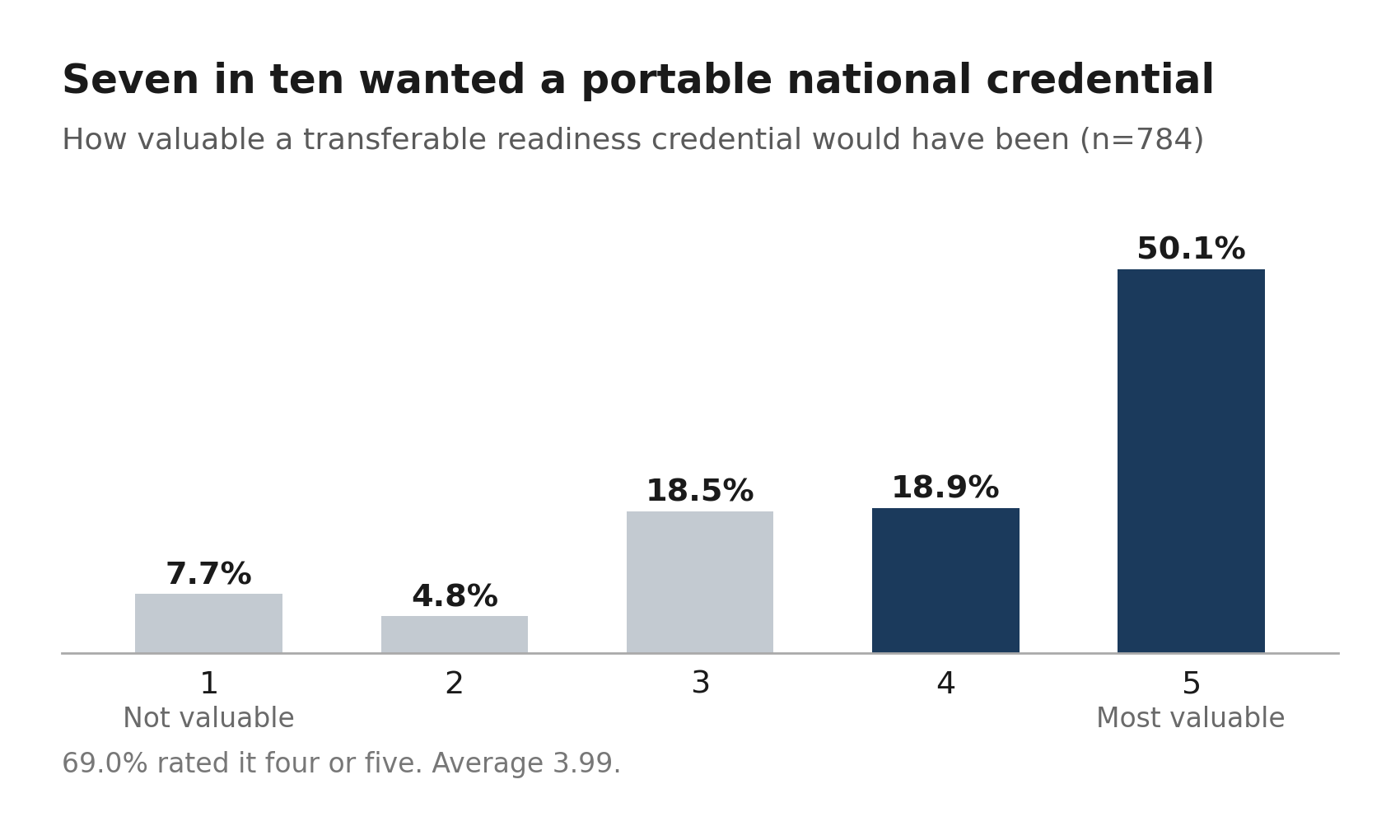
How valuable a transferable readiness credential would have been. Source: REMIC, The First 90 Days, 2026.
We asked agents to picture a credential that said they were ready to practise, recognized right across the industry, that moved with them to whichever brokerage they joined. How much would that have been worth to them starting out?
Half of them gave it five out of five. 69% gave it a four or a five. Average 3.99.
It held up across every cohort we have, from the people licensed before 2024 through to this year’s intake. It also held up regardless of how they’d been treated. Agents who got a proper program rated the idea 4.18. Agents who got nothing rated it 3.79. Both groups want it.
What we take from this
The first 90 days is the real gate into this business, and nobody is standing at it. FSRA sets the bar to get in. Past that point, how well an agent is prepared comes down to whichever brokerage happened to hire them, and a third of agents land somewhere that gives them nothing. There’s no floor under it.
The missing piece is teachable. Lender systems. Document requirements. Building a file. How a deal actually funds. Agents described the same wall over and over, and it sits in the gap between passing an exam and closing a first deal. Somebody should be filling it.
Agents want a portable standard of readiness. Seven in ten said a credential they could carry from brokerage to brokerage would have been valuable to them when they were starting out. That suggests substantial demand for an industry-recognized standard that sits between licensing and independent practice.
Method and limitations
- Sample. 880 responses collected between August 31 and September 14, 2026, from graduates of REMIC licensing courses. 784 were licensed. 96 completed a course but never registered. The survey is now closed.
- Cohorts. 353 licensed before 2024, 122 in 2024, 145 in 2025, and 164 in 2026.
- This is an Ontario picture. 772 of 784 licensed respondents, 98.5%, are licensed in Ontario. The other 12 are scattered across British Columbia, Alberta, Saskatchewan, Atlantic Canada, and more than one province. Read this as an Ontario study. Ontario is the biggest mortgage licensing market in the country and we’d be surprised if the pattern stopped at the border, but this survey doesn’t prove that and we’re not going to claim it does.
- Self-selection. Everyone here came from one education provider’s graduate list and chose to answer. Agents who feel strongly about how their first 90 days went, in either direction, were always more likely to respond.
- Recall. 45% of licensed respondents were licensed before 2024, so they’re describing a 90-day stretch that’s at least two years behind them. The credential question showed no meaningful drift between cohorts, but we can’t rule out recall effects on the training questions.
- We can’t report on brokerage networks. 260 respondents picked “Other” and another 115 picked “an independent brokerage,” and we gave them nowhere to type a name. That was our mistake. No network comparison can come out of this wave and none is offered here. It gets fixed in the next survey.
- Quotes. 489 respondents, 62.4%, gave us permission to quote them in some form. Every quote here sits inside the permission that person granted. Anyone who said no isn’t quoted and can’t be picked out of any figure on this page.
- Use of this data. The charts and figures on this page are free to reproduce with attribution to REMIC, The First 90 Days, 2026, and a link back to this page.
The wall agents kept describing is the one between passing the exam and closing a first deal. Lender policy, document requirements, and how a file actually gets built. That is exactly what Residential Mortgage Underwriting covers, and it carries CE credit toward your renewal.
The next wave runs in 2027 and it’ll be built to reach past Ontario. If you were licensed in the last three years and want to be counted, or you’re a brokerage owner who wants to talk about what a real first 90 days should look like, get in touch.
Joe White is the founder and CEO of the Real Estate and Mortgage Institute of Canada and was inducted into the Canadian Mortgage Hall of Fame in 2019.